
Marketing Budget Allocation for 2027: The Budget Holds, the Work Moves
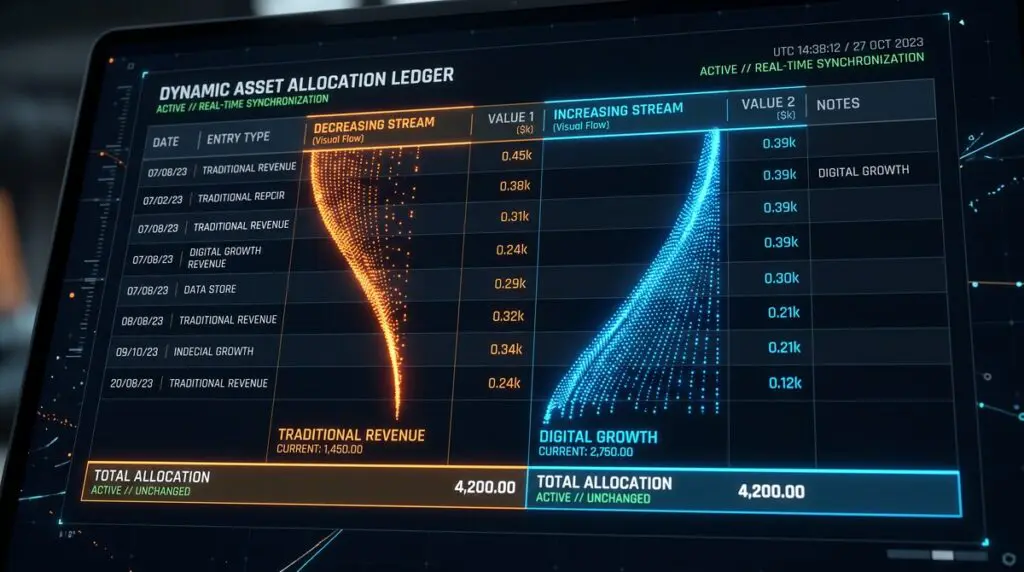
Retainers hold, value goes up, and deliverables pivot. Production takes a fraction of the time it did, so the money inside a 2027 marketing budget moves to the two things that still earn it. Judgment about what to run, and visibility in a market where attention costs more every year. The budget holds or grows; what it buys changes.
Most 2027 budgets are being set this quarter on line items inherited from a few years ago. This post is about which of those lines moved, what marketing budget allocation looks like once production is repriced, and where the room goes.
What changed about marketing budget allocation in 2026?
Two things moved in opposite directions. Production got faster, and visibility got harder.
A first draft of a blog post, twenty ad variants, a batch of imagery, a rough cut of a video. Each was a line item with days attached. Each now arrives before the planning meeting ends, with a strategist directing the output.
At the same time, Google’s share of search dipped below 90 percent in late 2024, the first time in a decade. AI answer engines started citing a handful of sources instead of ranking ten, and paid auctions got more crowded. There is more competition for fewer eyeballs, and staying visible costs more than it did.
Most marketing budget allocation frameworks have not caught up. The 70-20-10 rule, the percentage-by-channel splits, the templates in the top ten search results all allocate by channel. The split that matters now runs through every channel: production on one side, judgment and visibility on the other.
The costly mistake is cutting strategy and finish to fund tools, because that cuts the only part that still decides the outcome. A budget that leaves production at its old proportion is the smaller problem, and the fix is a reallocation, not a smaller number.
Which line items got faster because of AI?
Anything that is mostly volume moves faster now, and its share of the marketing budget shrinks. Four lines in particular.
First drafts of written content: blog posts, landing page copy, email sequences, social captions. The draft arrives in a fraction of the time. The hours move to deciding what it should argue and finishing it so a founder would sign it.
Fast for a freelancer with a tool, yes. Getting a team to the point where the draft is worth finishing took years of judgment to build.
Ad creative variants. Twenty headline and body combinations for a search campaign used to be a day of copywriting and design. The variants arrive quickly now, and the day goes to reading the results and choosing.
Imagery and first-pass video. Raw material and rough cuts arrive faster, so a studio day is no longer required for the first pass. The finished asset is still designed, directed, and art-directed by a person, and that is the part a client sees.
Research inventories and reporting. Pulling every competitor claim, every review, and every ranking page into one document took an analyst a week. Dashboards and monthly summaries assemble themselves from the data.
Reading them is a different line, and it is the reason agencies are hired now. The tool cannot discern which of two hundred observations matters, and it should not try. Nuance, guidance, guardrails, direction, vision, and the human read of what will land with a human audience: output without that buries the point.
Which line items did not?
Anything that requires knowing which of the many possible things to do is the right one. And anything that buys attention in a market where attention is scarcer.
Strategy and positioning. Deciding what the brand stands for, who it is for, and what the market needs to hear is judgment work. AI produces options, and it does not know which option is true of your business.
Compliance in regulated categories. Google’s healthcare policy, Meta’s personal attributes rules, HIPAA’s reach into tracking, state licensing boards’ definitions of advertising claims. The rules change quarterly, enforcement is automated, and the cost of being wrong is the ad account.
This line should grow, not shrink.
Brand finish. The difference between a draft that reads well and one a physician or a CFO would sign is a senior person’s edit. That edit is now a larger share of the work, because drafts arrive faster and there are more of them to judge.
Paid media. Platform costs did not fall. For the first time in a decade, Google’s market share is declining, so there is more competition for fewer eyeballs, and the cost of visibility has gone up.
Most brands now spend more to stay in the game at all, and how well the media is played drives the result. The judgment about where to put the spend and what to bid is worth more than it was.
Relationship and reading. The account lead who notices what a client keeps forwarding and what their recent asks have in common. The one who hands back the levers that matter when the client has no time for a plan.
No tool does this. Agency retainers earn their keep here.
What percentage of revenue should go to marketing in 2027?
The benchmark has held steady while the composition underneath it changed. Gartner’s CMO Spend Survey put marketing at 7.8 percent of revenue in 2026, after 7.7 percent in each of the two years before.
B2B companies with long sales cycles tend to sit below the average. Consumer and health brands with paid acquisition sit above it.
Treat the marketing budget percentage of revenue as a ceiling, not a target. The number worth setting is the split inside it, and in plain terms it looks like this.
A few years ago, a typical mid-market budget put about a third into making things and a third into media spend, with the rest on management, reporting, and tools. In 2027, making things should be under a tenth, and media spend should be close to half because visibility costs more. The strategy and finish layer takes what production gave up.
The total marketing budget does not fall. It holds, or it grows, and the difference is where it goes.
How should a $10K a month budget be allocated in 2027?
Here is a $10K a month marketing budget breakdown from a few years ago, carried into 2027. It grows to $12K because paid now carries organic, and visibility is a paid game.
| Line | Before | 2027 | What changed |
|---|---|---|---|
| Content production | $3,000 (30%) | $1,000 (8%) | Drafts, variants, and rough cuts arrive in a fraction of the time |
| Content strategy and finish | $500 (5%) | $2,000 (17%) | The room goes to deciding what to publish, finishing it, and getting it cited |
| Paid media spend | $3,000 (30%) | $5,500 (46%) | Visibility costs more; paid carries organic; spend roughly doubles |
| Paid media management | $1,500 (15%) | $1,800 (15%) | How well the media is played drives the result |
| Compliance and brand | $500 (5%) | $700 (6%) | Stricter platform rules, higher cost of error |
| Reporting and analytics | $1,000 (10%) | $500 (4%) | Assembly is automated; the fee covers interpretation |
| Tools | $500 (5%) | $500 (4%) | AI tooling replaces some software and adds other; net flat |
Same client, more budget, and a different shape. Content production falls by two-thirds while content strategy and finish quadruple, so the content line stays close to where it was and produces more.
Paid spend roughly doubles. Nothing is cut; the money changes jobs.
The proportions scale. A $25K a month marketing budget follows the same curve with larger numbers, and so does a $5K one.
Two exceptions run higher at every budget level. Regulated categories, because a flagged account costs the same regardless of the retainer, so compliance and finish carry more.
And startups or new brands with no citations, rank, or authority behind them. Visibility has to be bought until the brand has earned some, so paid carries more and content strategy builds the citations from zero.
One of our longest-running B2B accounts shows the shape. The retainer has held for years, and the work inside it has moved. It went from building the site and a content library to running paid search across markets and reading what comes back.
When it doubled spend on its strongest regional campaign, conversions nearly tripled. The account has beaten its year-over-year benchmarks every year since.
How do you tell if an agency is still charging for volume?
Ask what the fee buys now, not what it cost before.
Ask who decides what runs. If the answer is the person who made it, you are paying for production. If the answer is a strategist who reads the market and decides what should not ship, you are paying for judgment.
Ask who reads the output before you do. If it is the account coordinator, the work is being forwarded. If it is the senior person on your account, and they can tell you what they changed and why, it is being finished.
Ask where AI is used and where it is not allowed. An agency that will not answer is hiding the tool or has not thought about it. The right answer names what AI handles, what a senior person decides, and the review step between.
Ask how the media is being played. Visibility is more expensive than it was, so the question is what the spend is earning. An agency that shows you the bid strategy, the search terms it has excluded, and why, is playing the media. One that sends a spend report is not.
A retainer built this way looks the same on the invoice as it did two years ago and does different work. That is the shape to expect in 2027: the number holds, the deliverables pivot, and the value goes up.
That is how Savy runs its retainers: the fee is weighted to strategy, compliance, and finish, and the production share is directed rather than counted. The full scope of work is at savyagency.com/capabilities/.
Request a budget review. Send your 2026 marketing budget by line, or your current agency’s invoice. You get back the same budget re-cut for 2027, with the production share redirected to the lines that decide the outcome.
Recent Posts

Medical Practice Marketing When the Platforms Won’t Let You Say the Thing
Two constraints shape medical practice marketing. Google and Meta restrict what you can say: a condition, a prescription, a treatment outcome. HIPAA restricts what you can know about who you […]

SaaS Marketing Strategy: What Actually Drives Pipeline in 2026
SaaS is one of the most crowded categories in tech. Dozens of companies often solve the same problem with comparable feature sets and comparable pricing tiers. Buyers have endless options […]

Marketing for Healthtech Startups: From Launch to Scale
Healthtech founders carry a heavier marketing load than most. You are asking people to trust you with their health or their data. That trust has to be earned long before […]

AI-Powered Google Ads: How Top 3% Partners Use Machine Learning
Google Ads has always rewarded the brands that stay ahead of the platform’s capabilities. In 2026, that means knowing how to leverage machine learning and knowing when to override it. […]

The Strategic Naming Process: How Great Brand Names Are Built
A brand name is one of the most consequential decisions a business will ever make. It shapes first impressions and carries emotional weight. It becomes the single word (or two) […]